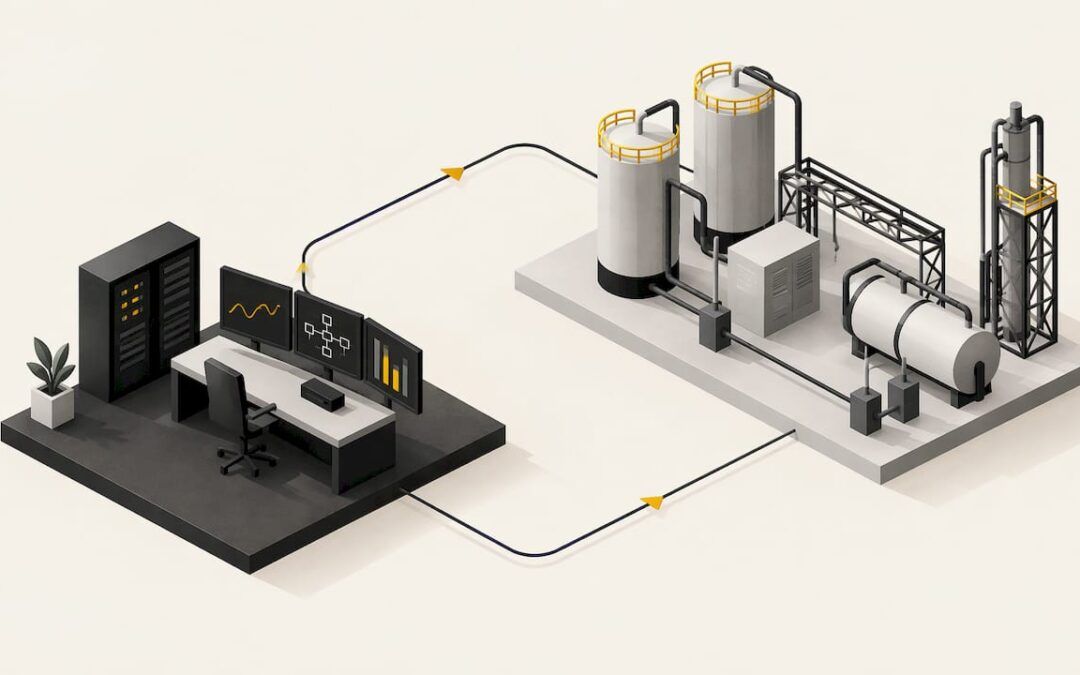
A good control systems course teaches you how a measured value (temperature, pressure, speed, position) is kept at a target by a controller, and then shows you how that idea runs on real hardware such as PLCs, drives and HMIs. University classes lean toward the math. Industrial training leans toward the equipment on your plant floor. Most working people need both, in the right order.
This guide explains what these courses cover, how feedback and PID show up in real plants, and how to match a course to your role, whether you are an engineer, a maintenance tech, a student or a manager building a team.
TL;DR
- Control systems training covers feedback loops, PID tuning, discrete and sequential logic, and the PLC, DCS and HMI platforms that run them.
- Theory-heavy university courses build the model-based understanding. Vendor-software training builds the skill to program and troubleshoot a machine.
- Pick by job: engineers need programming depth, maintenance staff need troubleshooting, students need fundamentals plus a software they can practice on.
- Hands-on practice with real software matters more than the number of lecture hours.
- Our PLC training courses and coaching are built for the practical side, at every skill level.
Table of Contents
- What a control systems course actually covers
- How feedback, modeling and PID work in real plants
- PLC, DCS and HMI: the platforms you will actually touch
- What to look for in industrial control systems training
- Choosing a path by role
- Our perspective on learning control systems
- Where our training fits
- Prerequisites and practice that make training stick
- Applying what you learn safely
- FAQ
- Sources
What a control systems course actually covers
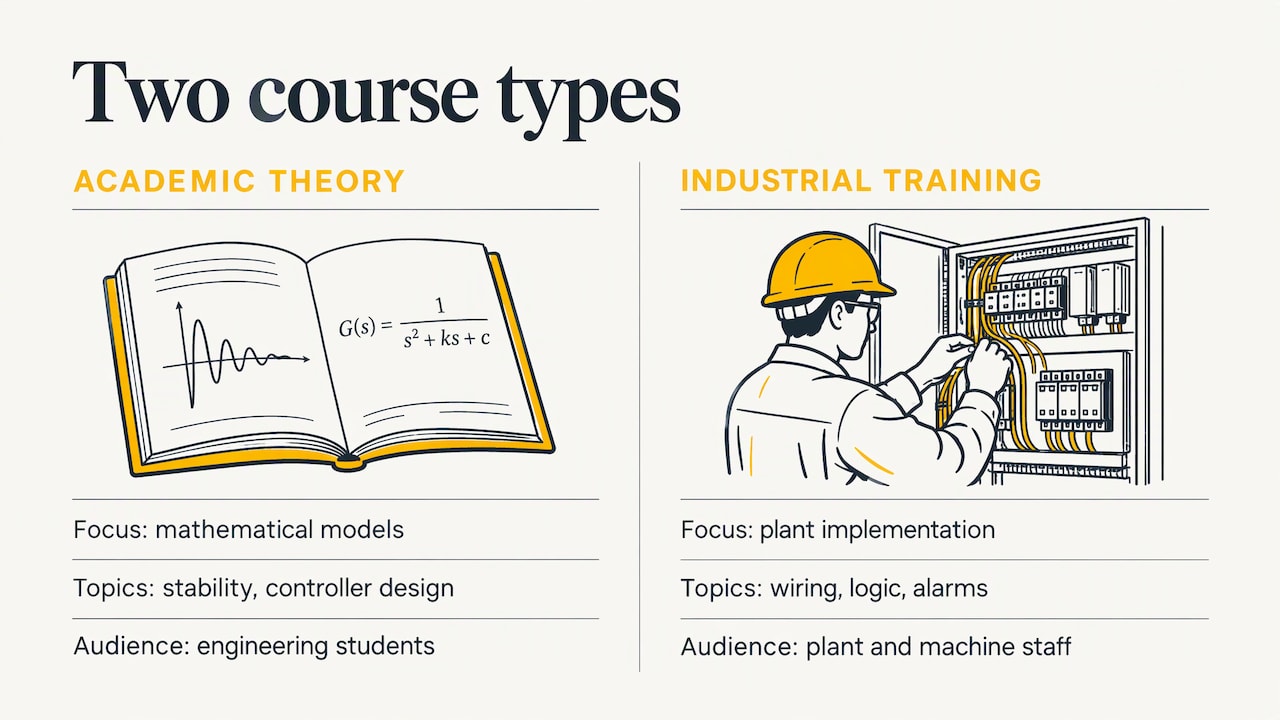
The label “control systems course” covers two quite different things, and search results mix them.
Academic control theory. These classes analyze systems with mathematical models. Typical topics are continuous-time classical control, stability, and designing controllers on paper or in simulation. A mechanical or electrical engineering student takes this as a credit course.
Industrial control training. This is aimed at people who keep plants and machines running. It covers how control is implemented: input and output wiring, ladder logic, process loops, alarms, operator screens and troubleshooting.
A free, widely used reference shows how broad the practical field is. The industrial automation textbook on Control.com, originally written by Tony R. Kuphaldt and released under a Creative Commons license, runs from relay control networks and basic PLCs through closed-loop control to PID tuning for process and motion control. That range is a fair outline of a complete curriculum.
Core topics you should expect
| Topic | What you learn | Where you use it |
|---|---|---|
| Discrete control | Ladder logic, interlocks, sequences, timers and counters | Machines, conveyors, packaging lines |
| Continuous control | Feedback loops, setpoints, PID tuning | Temperature, flow, level, pressure |
| Controller platforms | PLC programming, how PLCs differ from distributed control systems | Every automated site |
| Operator interfaces | HMI screens, alarms, trends | Machine panels and plant displays |
| Motion control | Drives, servos, axis tuning | Assembly, packaging, material handling |
| Troubleshooting | Reading code online, tracing faults, isolating field devices | Downtime response |
| Documentation | Drawings, symbols, I/O lists | Commissioning and maintenance |
If a course outline has none of the practical rows, it is a theory course. If it has none of the feedback and tuning material, it is a programming course. Neither is wrong, but you should know which one you are buying.
How feedback, modeling and PID work in real plants
Feedback control compares a measured value with a setpoint and adjusts an output to close the gap. That one idea is the base of almost everything else you will learn.
PID is the workhorse. The Caltech textbook Feedback Systems states that PID is by far the most common way of using feedback in engineering systems, from small dedicated devices to large factories with thousands of controllers. It also points out that advanced control methods have not reduced the importance of PID: higher-level controllers typically hand setpoints down to PID controllers in a lower layer, so overall performance depends on how well those loops behave.
That is why tuning is a skill worth paying for. A badly tuned loop wastes material, swings around its setpoint or reacts too slowly.
Why real loops are harder than textbook loops
In a process plant, loops face disturbances, transport delay, slow dynamics and interaction between variables. An AIChE article by Cecil Smith on process control notes that single-loop PID needs the controlled and manipulated variables paired correctly, and that interaction between loops has to be handled in demanding applications such as distillation columns. It also observes that many processes are commissioned without dynamic modeling.
Two practical lessons follow:
- Learn what the process does when you move the output. Step a valve a few percent in manual and watch the response before you touch any tuning constant.
- Understand which variable you are really controlling. Pairing the wrong input and output is a design mistake that no amount of tuning will fix.
Feedback is reactive, feedforward is proactive
A feedback controller only acts once the measured value has started to drift from its setpoint. A Wiley process control chapter explains that combining feedback with feedforward control, which responds as soon as a disturbance is detected, can improve performance. The same chapter notes that in a modern DCS, data is sampled at a fixed rate, so the discrete-time view of a response, expressed as a difference equation, replaces the continuous-time one.
You do not need to derive any of that to be useful on the job, but knowing why a PLC scan time or loop update rate matters will make your troubleshooting sharper.
PLC, DCS and HMI: the platforms you will actually touch
Most control systems training eventually lands on a platform. In North American plants, that often means Allen-Bradley hardware programmed in RSLogix 500, RSLogix 5000 or Studio 5000, with operator screens built in FactoryTalk View. Those are the tools our own courses use.
A few distinctions help when you read a course outline:
- PLC: typically strongest at fast discrete logic, machine sequencing and motion.
- DCS: typically used for large continuous processes with many loops and a plant-wide operator environment.
- HMI: the window into either one. Good HMI training covers screen layout, alarms and navigation, not just button graphics.
HMI hardware is a design choice as well as a software one. If you are specifying panels, a comparison of membrane switches and touchscreens shows how the interface type changes durability and operator experience in industrial settings.
What to look for in industrial control systems training
Whether you want an “industrial control systems course” or general control systems training, judge any program against the same checklist.
Real equipment and real software
You learn ladder logic by writing it, downloading it and watching it fail. Look for courses that use the same software your employer uses, with examples taken from actual machines rather than abstract exercises.
A clear sequence
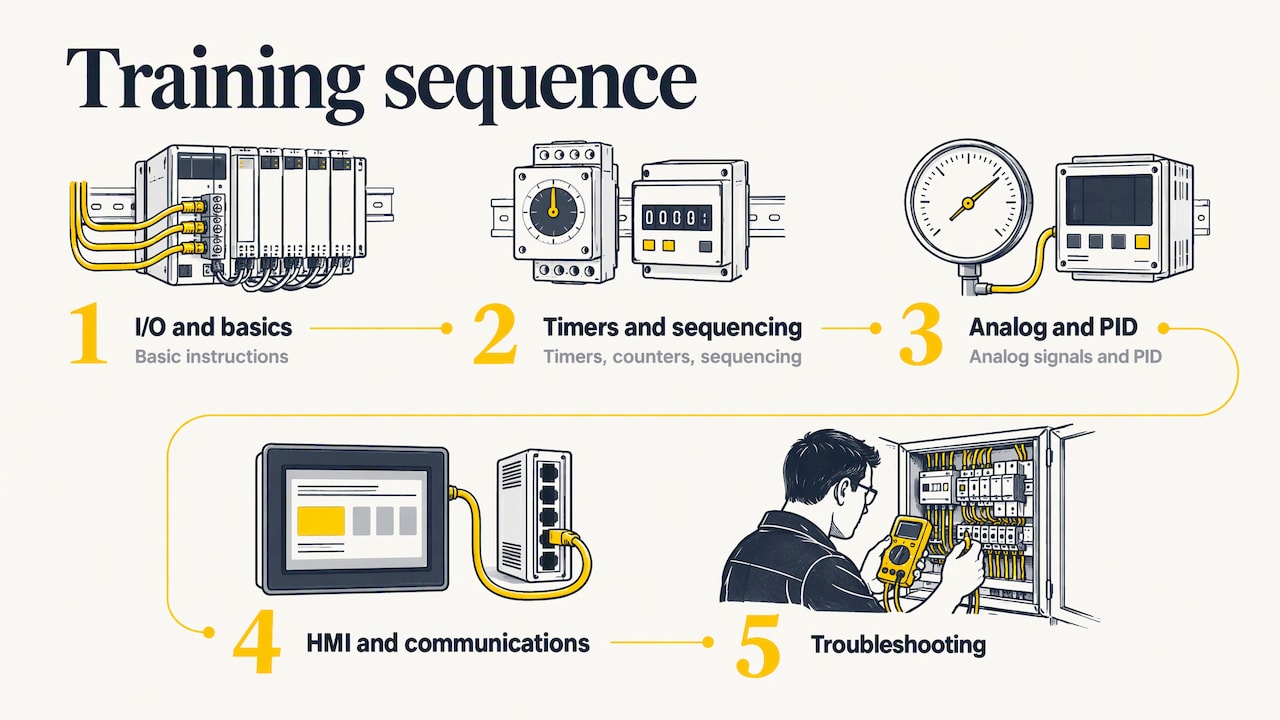
Good training builds in layers: I/O and basic instructions, then timers, counters and sequencing, then analog signals and PID, then HMI and communications, then troubleshooting. If lessons jump around, you will spend time filling in gaps.
Troubleshooting as a core skill
Programming gets a machine started. Troubleshooting keeps it running. Courses that teach you to go online with a controller, read the logic and trace a fault to a sensor, wiring issue or program error pay back fastest for maintenance teams.
Pacing you control
Working professionals rarely get a free week. On-demand video that you can pause, rewind and repeat on your own schedule fits shift work and project deadlines better than a fixed classroom week.
Support when you get stuck
Video alone has a ceiling. The moment your own project behaves differently from the lesson, you want somebody to ask. Coaching or a membership with ongoing access fills that gap.
Choosing a path by role
| If you are… | Start with | Then add |
|---|---|---|
| A student | Fundamentals of feedback, ladder logic and one major PLC platform | PID and a small personal project |
| A maintenance technician | Reading and troubleshooting live PLC programs | HMI, drives, and communications |
| A controls or project engineer | Structured programming and standards in your platform | Motion control and advanced HMI |
| A manager building a team | A common baseline course for everyone | Role-specific modules and coaching |
If you want a neutral way to map your skills before spending anything, the ISA Skills Development Resource Navigator is a free self-assessment that suggests resources based on your job role, desired skill and current and target skill levels.
Our perspective on learning control systems
We have watched a lot of capable people stall in control systems because the training they found was either generic or expensive. Theory-only courses leave you unable to open a program on a real machine. Costly bootcamps assume you can take a week away from work.
Our approach is built around practical examples, clear structure and content designed for all skill levels. We teach with industry-standard software, including RSLogix 500, RSLogix 5000, Studio 5000 and FactoryTalk View Studio, and we keep updating the material so it stays current.
The sequence we recommend is simple: get the logic fundamentals solid, learn to troubleshoot a running program, then add specialties such as HMI, drives and servo motion. Video lessons carry the core material. Coaching sits on top for the day your own machine does something the lesson did not cover.
That mix of on-demand training and direct help is what turns a course into a skill you can use on Monday morning.
the author
Where our training fits
Our Allen-Bradley and advanced PLC training catalog includes Allen Bradley PLC Training, Powerflex 525 Course, FactoryTalk View ME Training, Servo Motion Mastery, Advanced Servo Motion Mastery and PLC Controls University. Prices for these are listed on the course pages.
If you prefer one-to-one help, our online PLC coaching starts from $67 per session, and the 90-minute coaching session is $97 per session. The Yearly PLC Training Membership is $192 per year. If you need a program written for you, our PLC programming services are $140 per hour, with a 10-hour project package at $1,400 and a 20-hour package at $2,800. You can also read student feedback on our PLC training before you decide.
Prerequisites and practice that make training stick
You do not need an engineering degree to start industrial control training. A working grasp of basic electricity (voltage, current, switches, relays) and comfort reading a simple wiring diagram will carry you through most introductory material. Academic control theory is where calculus and differential equations come in.
A few habits make the biggest difference:
- Practice on the same platform every week. Short, frequent sessions in the software beat one long weekend.
- Rebuild each lesson from a blank project. Copying a finished program teaches little. Writing it from scratch shows what you actually understood.
- Break things on purpose. Force a fault in a simulated or bench setup, then find it with the online editor.
- Keep a notebook of patterns. Start/stop seal-ins, alarm latches, sequencers and scaling routines come up on almost every project.
- Use free references for gaps. The Control.com textbook above is a good companion when you want a second explanation of a concept.
If you are targeting a career move, our pages on PLC programming salary in the US give context for what the skills are worth.
Applying what you learn safely
Training ends at the classroom door, but the equipment does not. Treat any live machine as a place where your program can move something heavy.
- Practice on simulators or a bench controller first. Test logic away from production equipment before it goes near a running line.
- Follow your site’s lockout/tagout and safety procedures whenever you work near powered equipment, and do not bypass guards, interlocks or safety circuits to test code.
- Do not change a running program on production equipment unless your employer’s change procedures allow it and a qualified person has approved it. Save a backup of the existing program before any edit.
- Ask your supervisor or a qualified controls engineer about any machine whose hazards you do not fully understand.
These habits are not extras. They are part of working competence in controls.
FAQ
What is the difference between a control systems course and a PLC course?
A control systems course teaches the broader principles: feedback, PID, process dynamics and system behavior. A PLC course teaches how to program one type of controller, mainly discrete logic. Most plant roles need both, and a PLC course that includes analog and PID material covers a good share of the overlap.
Do I need advanced math for industrial control systems training?
Not for most hands-on programs. Basic algebra and electrical fundamentals are enough to learn ladder logic, troubleshooting and basic PID tuning. Advanced math matters mainly in university courses focused on modeling and controller design.
How long does it take to learn PLC and control skills?
It depends on your starting point and how often you practice. Many learners get comfortable with basic programming over several weeks of regular study, while troubleshooting speed and tuning judgment build over months on real equipment. Steady weekly practice matters more than total hours.
Is online training enough, or do I need a classroom?
On-demand online training works well when it uses real software and gives you a way to ask questions. We pair video courses with optional coaching for exactly that reason, so you can get help on your own project without leaving your job.
Sources
- Control.com: Textbook for Industrial Automation & Control
- Caltech: Feedback Systems, PID control chapter
- AIChE: Process Control for the Process Industries, Part 1
- Wiley: Process Dynamics and Process Control, excerpt
- ISA Skills Development Resource Navigator
- Membrane Switch vs. Touch Screen for industrial HMI