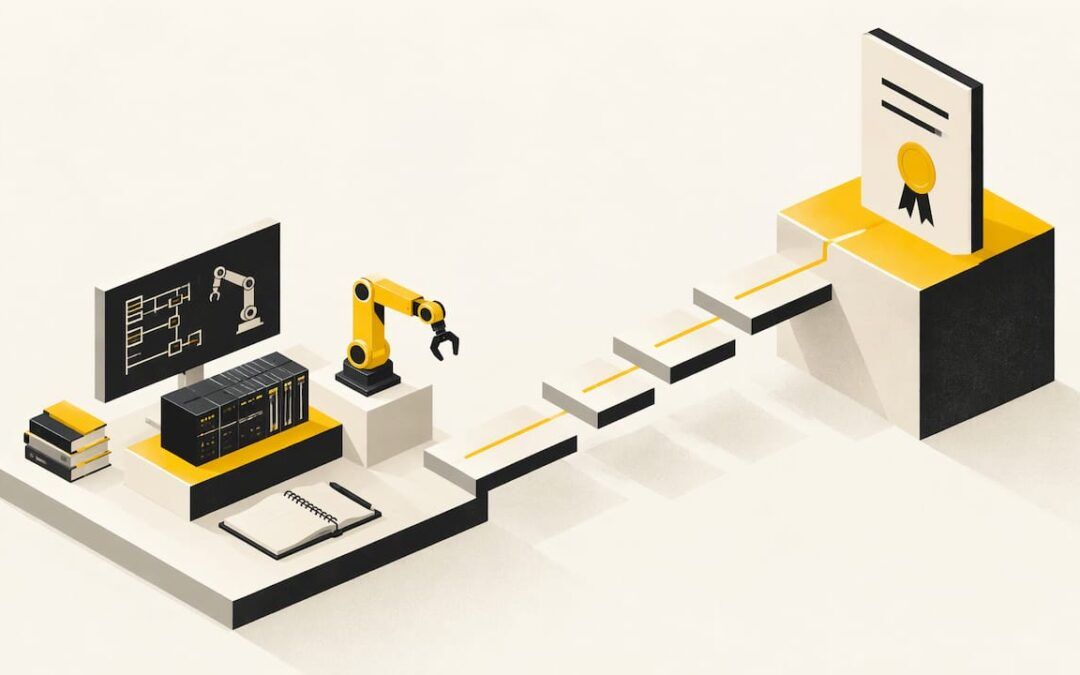
Industrial automation certification training comes in two parts that people often blur together: a course that teaches you the skills, and a credential that an outside body awards after you prove them. The strongest path usually does both in order. You learn to program, wire and troubleshoot a PLC on real software, then you pick the credential that fits your job, your experience and your employer.
This guide explains what each part involves, what the main US credentials require and cost, and how to build hands-on skill that makes any exam easier.
TL;DR
- A course teaches you to do the work. A certification is a third party confirming you can. Most people need the course first.
- Good training covers safety, PLC components, ladder logic, addressing and tags, running programs, and troubleshooting I/O and field devices.
- ISA’s Certified Automation Professional (CAP) is experience-based and priced in the hundreds of dollars. SACA credentials are modular and include a hands-on assessment on approved equipment.
- Hands-on practice with real PLC software matters more than watching lectures. Build, break and fix programs.
- If you want a practical, affordable starting point, our PLC training courses and coaching are built for that.
Table of Contents
- Course versus certification: what is the difference?
- What industrial automation training should teach
- The main certification routes in the US
- What it costs and how long it takes
- How to get real hands-on practice
- Applying PLC training on the job
- Choosing your path: a simple decision process
- Our perspective
- Start with practical PLC training
- FAQ
- Sources
Course versus certification: what is the difference?
A training course gives you knowledge and practice. You finish when you have worked through the material. A certification is different: an independent organization sets a standard, tests you against it, and awards a credential you can show an employer.
That difference matters when you plan your time and budget. A certification exam does not teach you ladder logic. It assumes you already know it. If you sit an exam without practice on real controllers, you risk paying a non-refundable fee to find out where your gaps are.
Some credentials also come with eligibility rules. The Smart Automation Certification Alliance (SACA) requires candidates to be employees or students of a SACA member, and ISA’s CAP asks for years of documented work. So the question is rarely “which certificate is best?” It is “which one can I qualify for, and what do I need to learn to pass it?”
What industrial automation training should teach
Whatever label a program uses, the content should match the work you will do on a plant floor. A useful benchmark is the PLC course alignment document from the Kansas Regents, developed in June 2024 for a three-credit-hour course. It lists competencies that read like a job description:
- Demonstrating safety procedures
- Connecting a PLC to a programming device with proper wiring
- Identifying PLC types and components
- Understanding relay ladder logic symbols
- Describing addressing and tags
- Developing functional PLC programs
- Executing and monitoring programs
- Troubleshooting PLC systems, including I/O sections and related field devices
Notice the last item. Troubleshooting is not an afterthought. Most of a maintenance technician’s value comes from reading a program online, finding why an output is not turning on, and tracing the problem to a sensor, a wire, a card or a rung of logic.
Beyond core PLC skills, broader automation training spans a lot of ground. ISA’s training library for factory automation and machine control covers PLCs and PACs, motors and drives, machine safety, HMI, motion control, robotics, vision systems, sensors and industrial I/O. You do not need all of it on day one. Start with PLC logic and HMI, then add drives, motion or robotics as your job demands.
Software matters as much as theory
In US plants, a large share of controllers are programmed in Rockwell Automation environments such as RSLogix 500, RSLogix 5000 and Studio 5000, with FactoryTalk View for operator screens. Learning the concepts is step one. Learning where the buttons are in the software your employer actually uses is what makes you productive in the first week.
If that is your environment, our free Studio 5000 ladder logic tutorial and the Allen-Bradley PLC guide for beginners show the basics on the real software.
The main certification routes in the US
There is no single national automation license. Instead, several bodies and programs offer credentials aimed at different people. Here is how three common routes compare, using each body’s own published requirements.
| Route | Who it suits | How you qualify | Assessment | Published cost |
|---|---|---|---|---|
| ISA Certified Automation Professional (CAP) | Experienced engineers and senior technicians | Four-year technical degree plus five years of automation work, or a two-year degree or no degree plus ten years | Closed-book exam, 175 multiple-choice questions, four hours | $373 members, $467 non-members |
| SACA Smart Automation certifications | Students and employees of SACA member organizations | Membership affiliation; no specific course or equipment brand required | Proctored online written exam plus hands-on performance assessment | Varies by credential and state program |
| State workforce credentials (for example Indiana C-207) | Students and incumbent workers in state programs | 80 to 85 related instructional hours | Hands-on practical plus online written exam | $500 with SACA membership (October 2023 summary) |
ISA CAP: for experienced professionals
The CAP is built around documented experience. ISA requires either a four-year technical degree and five years (7,500 documented hours) of automation work, or a two-year degree or no degree with ten years (15,000 hours). The longer route also requires two years in a responsible-charge position, and ISA may audit your evidence.
The exam itself is closed book, has 175 multiple-choice questions and lasts four hours, and you can take it online or at a testing center. The same FAQ lists the fee at $373 for members and $467 for non-members, and application fees are non-refundable. Renewal comes every three years: 150 professional-development points, at $270 for members or $340 for non-members, or an exam retake at $336 and $420.
ISA also offers the Certified Control Systems Technician (CCST) credential, along with exam prep, through its training catalog.
SACA: modular and hands-on
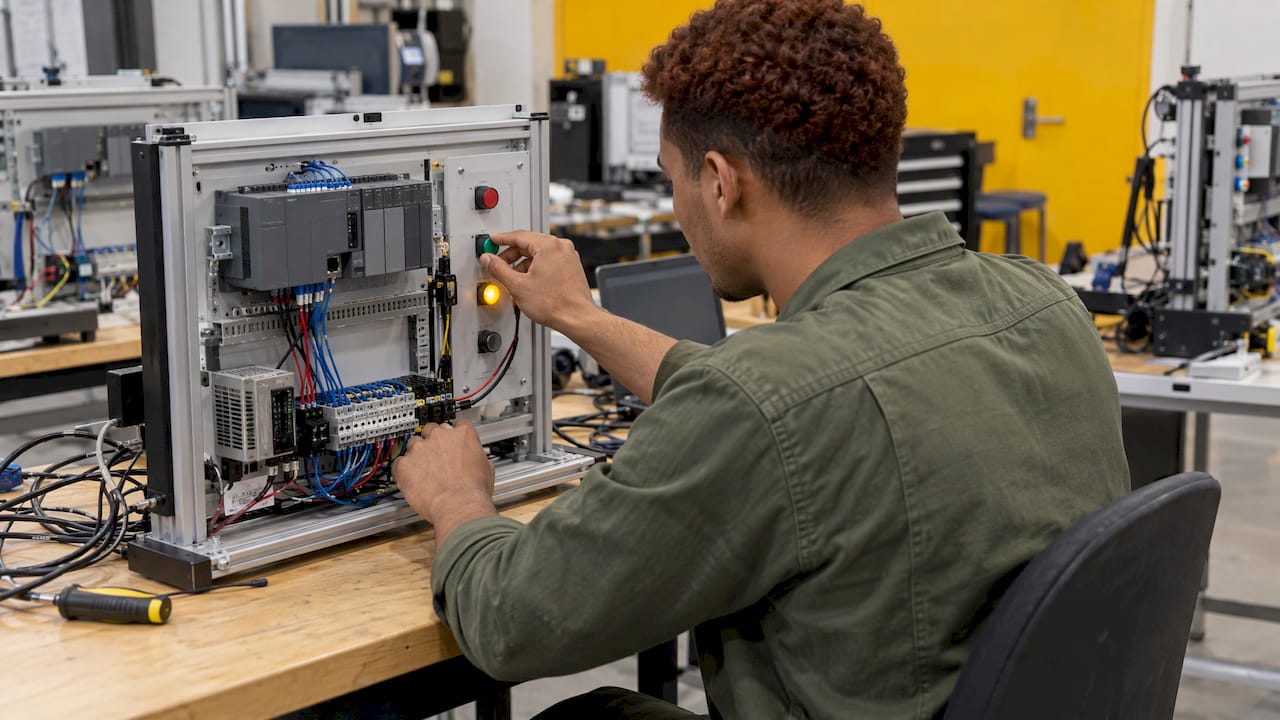
SACA’s certifications are stackable in three categories: Associate, Specialist and Professional. You pass a proctored online written exam to earn a Silver Credential, then a hands-on performance assessment on SACA-approved equipment for the full Gold certification. SACA says no particular course or training-equipment brand is required to prepare, so you can build your skills however you like, as long as you can perform on the assessment day.
That last point is useful. It means self-paced training on the software and hardware you can access is a legitimate preparation route, provided you practice the actual tasks and not just the theory.
State credentials and community college programs
Many states map credentials onto college and workforce programs. Indiana’s summary for C-207 Programmable Controller Systems 1 lists 80 to 85 related instructional hours, a hands-on practical assessment plus an online written test, and a $500 exam cost with SACA membership. The credential does not expire, though membership must be renewed. Fees and rules change, so check your own state’s workforce or education agency for the current picture.
What it costs and how long it takes
Budget for three things: learning, exam fees and renewal.
- Learning. A college course, a vendor class or an online program. Prices vary widely, from low-cost on-demand video to multi-day instructor-led sessions.
- Exam fees. The published figures above run from roughly $373 to $500 per attempt, and fees may not be refundable.
- Renewal. ISA’s CAP renews every three years with a fee. Indiana’s C-207 credential itself does not expire.
Time depends on where you start. A structured PLC fundamentals course of 80 to 85 instructional hours, like the one in Indiana’s summary, is a reasonable benchmark for a first credential. Experience-based credentials such as the CAP take years of work history before you can even apply.
If you are paying out of your own pocket, keep the learning step lean. A well-built on-demand course and a few coaching sessions can take you a long way before you spend on an exam.
How to get real hands-on practice
Certification boards say it plainly: they want to see you do the work. SACA’s own description stresses that candidates should be able to “do” as well as “know” through a proctored hands-on evaluation. So practice has to be hands-on.
Good practice looks like this:
- Use real programming software. Simulators and emulators are fine for logic. Nothing replaces going online with a controller if you can get access to one.
- Build small, complete projects. A traffic light sequence, a motor start/stop with interlocks, a tank-fill routine. Our Allen-Bradley traffic light exercise is a classic first build.
- Add an operator screen. Connect an HMI to your PLC tags so you see both sides. Our walkthrough on how an HMI communicates with a PLC program covers the links between them.
- Break things on purpose. Force an input, unplug a wire, change an address, and practice finding the fault.
Educators are making the same point. A paper from the Micro Nano Technology Education Center argues that many college labs present subsystems as closed boxes, which limits students’ ability to observe, validate and troubleshoot behavior from start to finish. Their lab links a webcam-based inference application to an Allen-Bradley ControlLogix PLC so students can see exactly how a software result becomes controller behavior. The takeaway for any learner: choose training where you can see the logic, not just the result.
Applying PLC training on the job
Training pays off when it changes what you do on a shift. Here is how the skills map to common tasks.
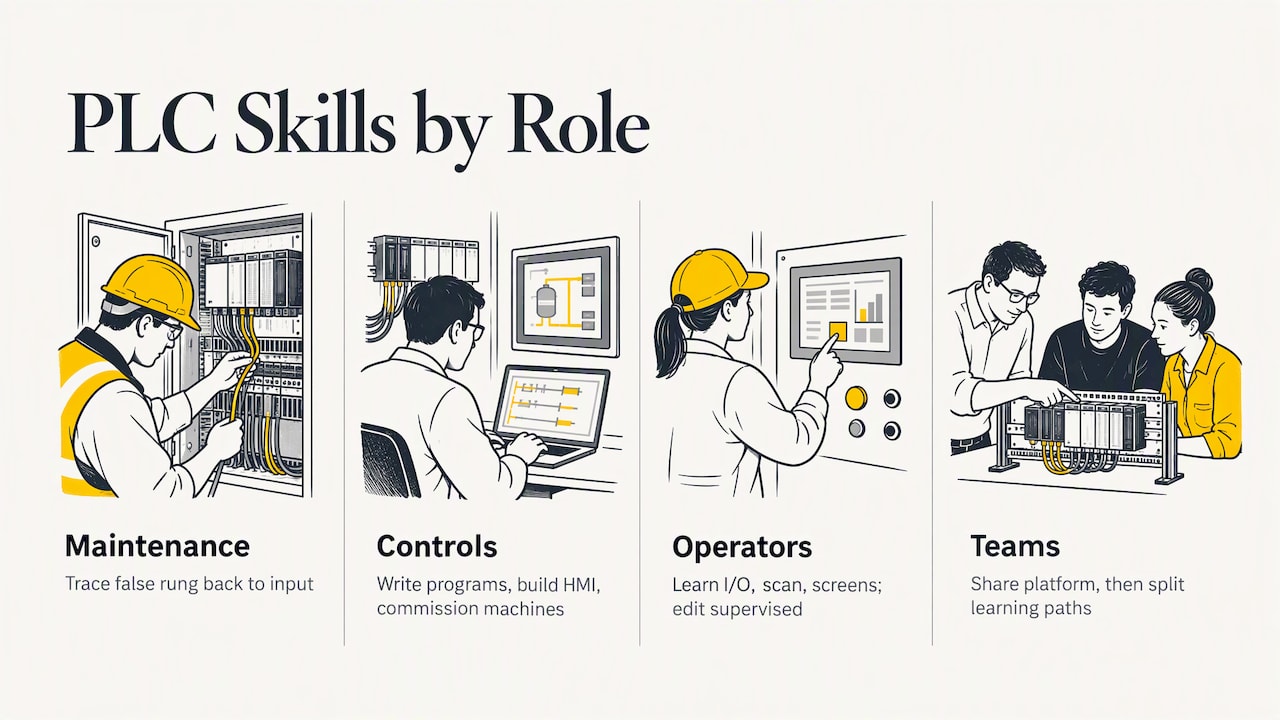
Maintenance technicians. The most direct use is troubleshooting. When a machine stops, you open the program online, find the rung that is false, and follow it back to the input. That workflow is exactly the troubleshooting competency in the Kansas alignment: I/O sections and related field devices. Practice reading ladder logic quickly and identifying which condition is blocking an output.
Controls and automation engineers. You write and modify programs, build HMI screens and commission machines. Structured tags, consistent naming and clean routines make your code something the next person can support. Our PLC programming system and PLC programming controls pages explain how we approach that.
Operators and new hires moving into technical roles. Start with the basics: how inputs and outputs map to addresses, how the processor scans, and how to read a screen. Then move to small edits under supervision.
Companies upskilling a team. Set a shared baseline first, using one platform and one naming standard. Then split paths: maintenance staff go deeper on troubleshooting, engineers on motion, drives and HMI. Certification can come later for those whose roles or customers require it.
If you are weighing the career side, our pages on PLC programming salary in the US discuss what skills tend to be rewarded.
Choosing your path: a simple decision process
- Name your goal. Are you getting hired, getting promoted, fixing machines faster, or meeting a customer or employer requirement?
- Check eligibility. For ISA’s CAP, count your documented hours. For SACA credentials, ask whether your employer or school is a member.
- Identify your platform. If your plant runs Allen-Bradley, train on Studio 5000 and FactoryTalk, not on a brand you will never touch.
- Build skills first. Work through structured training and practice projects until you can build, run and troubleshoot without notes.
- Then pick the exam. Match it to your experience level and budget, and confirm current fees on the issuing body’s own page.
- Plan renewal. Know what keeps the credential active before you pay for it.
Our perspective
We hear the same story from students, technicians and engineers: the credential feels like the goal, but what actually changes their working life is being able to open a program and understand it.
That is why we build our training around real software, real examples and troubleshooting, using the tools in industrial plants, such as Studio 5000 and FactoryTalk View. Our approach is designed to be practical, cost-effective and clear for every skill level, whether you have never opened a ladder logic editor or you are sharpening motion and HMI skills.
Certifications are worth pursuing when your role calls for them. We think the order matters, though: get the hands-on ability first, and an exam becomes a confirmation of what you can already do.
the author
Start with practical PLC training
Our on-demand programs cover Allen-Bradley PLC training, FactoryTalk View ME, PowerFlex 525 drives, servo motion and more, all on our PLC training page. If you prefer working through your own problems with an expert, Online PLC Coaching starts from $67 per session, and the 90-minute PLC coaching session is $97 per session on our products page. The Yearly PLC Training Membership is $192 per year.
For teams, our PLC programming services are $140 per hour, with 10-hour and 20-hour project packages at $1,400 and $2,800, so you can get a machine running while your people learn from the code. Details are on our programming services page. Want to see what other learners say first? Read a PLC course review.
FAQ
Is an automation certification required to work with PLCs?
No single certification is legally required to program or maintain PLCs in the US. Employers usually look for demonstrated skill, and some roles or customers ask for a specific credential. Check job postings and your employer’s requirements before you pay for an exam.
How much does an industrial automation certification cost?
Published exam fees run from $373 for ISA members and $467 for non-members on the CAP, to $500 for Indiana’s C-207 credential with SACA membership (an October 2023 figure). Renewal and training costs are extra, so confirm current numbers with the issuing body.
Can I prepare for a certification on my own?
Often yes. SACA says no specific course or equipment brand is required for preparation, though the hands-on assessment uses SACA-approved equipment. Structured video training, practice projects and coaching help you build the skills you will be tested on.
How long does it take to get ready?
A foundational PLC credential such as Indiana’s C-207 lists 80 to 85 instructional hours. Experience-based credentials like the ISA CAP depend on years of documented work rather than class time.
Which should I learn first: PLCs or HMI?
Start with PLC logic, addressing and troubleshooting, then add HMI so you can see how operator screens read and write controller tags. Both skills show up together on most real machines.
Sources
- ISA Training Courses by Topic
- Kansas Regents, Programmable Logic Controllers (PLC) alignment
- SACA Smart Automation Certifications
- Indiana C-207 Programmable Controller Systems 1
- ISA CAP requirements
- ISA Certification FAQs
- ISA Recertification
- Micro Nano Technology Education Center, Bridging the Gaps